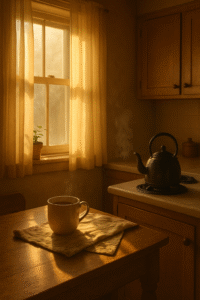
 On Sundays, my house becomes a softer place. Light drips through the curtains like warm honey, the kettle hums its low morning song, and the world feels briefly negotiable. That particular Sunday, I sat alone in my study with a fresh cup of coffee and a new leather diary resting on the desk. The diary smelled of earth and winter—the kind of scent that whispers that beginnings never arrive loudly.
When I opened it, the pages gave a faint rustle, like someone clearing their throat before speaking.
Go on, they seemed to say.
Tell the truth.
I tried.
I wrote about how, despite nothing in my life looking dramatically different from the year before, everything inside me had shifted in quiet, irreversible ways. Turning points don’t come with fanfare; they come disguised as normal days. I wrote down the small pivots that have shaped me—leaving cities, leaving people, falling in love, falling apart, rebuilding, losing again, learning the same lesson twice. Maybe three times.
Life, I wrote, is not a series of events but a series of awakenings.
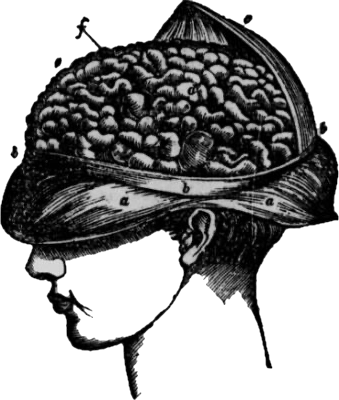
I paused, letting the ink dry, and wondered why no one prepares us for the things that matter. We are taught how to add fractions, how to write topic sentences, how to shake hands firmly—but not how to hold sadness without drowning in it, or how to forgive ourselves after years of being our harshest critic. No one explains the architecture of the mind or the storms it can generate.
I was lost in those thoughts when I heard the softest voice behind me.
“Muma?”
My son stood there, small and hopeful, holding his kindergarten book like an offering.
“Will you read me a story?”
It took only a second for the room to shift—the study dissolving into a memory of my father reading to me when I was his age. My father would make up stories out of thin air, weaving worlds where I was always the hero, always chosen, always enough. I lived inside those stories long after he closed the book. Some days, I still do.
Back then, I carried my imagination like armor. I believed life would bend toward my desires simply because I felt them so intensely. For years, it worked. I manifested small miracles: the right opportunities, the right people, the right moments. I was buoyant, unburdened, almost enchanted.
But enchantment has an expiration date.
Sometime in my late twenties, the world began to weigh differently. Expectations thickened around me—career stability, financial sense, a partner, a plan, a future I could explain to others. My rose-colored glasses fogged over until the world grew grey at the edges.
I lost myself in that grey.
I didn’t break dramatically. I eroded quietly. One day I looked around and realized I no longer recognized my life or the woman living it. Loneliness settled in like a permanent tenant. The future felt too heavy to hold, and the past kept tugging at my sleeves.
Around thirty, out of desperation more than devotion, I turned inward. Slowly. Awkwardly. Like someone relearning how to walk.
I read obsessively—Yogananda on the soul, Abraham Hicks on thought, Joe Dispenza on mind, Julia Cameron on creativity, Aristotle on reason. They said the same thing in different languages:
You shape your life from the inside out.
The mind is not a mirror; it is a paintbrush.
It wasn’t a single moment that changed me but the accumulation of small ones—breaths taken intentionally, thoughts paused before believed, pages written instead of swallowed.
That Sunday morning, standing in my study with my son waiting beside me, I realized I wasn’t just holding his book. I was holding the opportunity to rewrite the story for both of us.
“Come here,” I said, lifting him onto my lap.
He settled in, warm and trusting, his head tucked under my chin. As I began to read, his small fingers traced the pictures as though he were entering the story himself.
I thought about the things I wanted to pass down to him—not money or achievements or the illusion of perfection. But the skills that might save him one day: how to sit with fear, how to soften disappointment, how to listen to his body when his mind is loud, how to trust his inner world even when the outer one feels demanding and strange.
As I read, he looked up at me and smiled in that unguarded way only children can. I pressed a kiss into his hair and felt something settle quietly inside me, something I hadn’t felt since girlhood.
It was the return of color.
Not the vibrant pink of old rose-colored glasses, but a new kind—soft, earned, real.
After I tucked him in for his nap, I returned to my diary.
The pages waited.
This time, I wrote not about what I had lost, but about what I was learning to reclaim:
my wonder,
my inner steadiness,
my ability to imagine possibilities before seeing proof of them.
Some pages life turns for you.
Some you turn yourself.
And some, like this, you turn for the sake of someone who will one day read your story and find their own strength in the margins.